


The U.S.–Israeli war on Iran has reopened the prospect of a new phase of regional instability in the Middle East. Its repercussions are not confined to the direct parties to the conflict; rather, they extend to other arenas intertwined with the region’s broader strategic balances. In this context, Syria emerges as one of the states most sensitive to these developments,…
Read More »Commentaries

The hypothetical absence of Iran’s Supreme Leader can be understood as a potentially pivotal moment, though not necessarily as an automatic collapse of the regional balance of power. Since the 1979 revolution, the Iranian political system has not been constructed around a single individual; rather, it rests on a complex institutional–security–ideological architecture in which power is distributed among the religious…
Read More »
• The escalation between the United States, Iran, and Israel represents a structural shock to the global energy system rather than merely a temporary military crisis.• Energy security has become an integral component of geopolitical deterrence calculations, not solely an economic matter.• The Strait of Hormuz constitutes the most critical chokepoint in the global economy due to the concentration of…
Read More »
In an attempt to conceal the state of regional isolation into which Israel has been placed, Israeli Prime Minister Benjamin Netanyahu spoke of a new axis being formed by Israel in coordination and cooperation with India and a number of Arab, African, and Mediterranean countries. He concealed some names while mentioning others such as Greece and Cyprus. It is not…
Read More »
On 6 February 2026, Syria’s General Authority for Land and Sea Ports issued a decision restricting the entry of foreign (non-Syrian) trucks into Syrian territory, with a limited exception for transit shipments under customs escort to ensure that cargo is not unloaded inside Syria. In practice, the decision institutionalizes the “Back-to-Back” mechanism, which requires incoming trucks to unload their cargo…
Read More »
During periods of stability, political systems tend to elevate their most visible and charismatic figures. In moments of existential danger, however-when the prospect of a sudden leadership vacuum looms-the criteria of selection may be inverted entirely. Popularity and rhetorical prominence recede in importance, giving way to the imperative of continuity. In such moments, regimes search for a “transitional manager.” It…
Read More »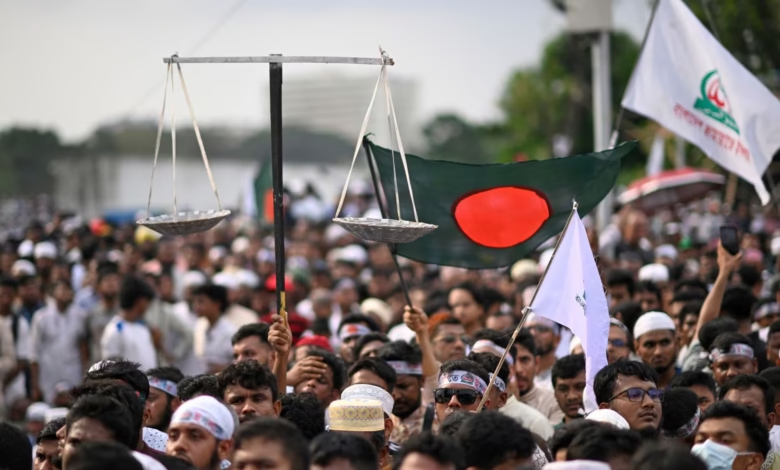
Elections constitute pivotal moments that not only reflect the will of voters but may also reveal shifts in the internal balance of political power within a state-particularly when their outcomes diverge from patterns that have long defined the political landscape. This is currently evident in Bangladesh following the announcement of parliamentary election results, which showed the Bangladesh Nationalist Party securing…
Read More »
Ramadan is approaching amid escalating challenges imposed by the Israeli police inside the Al-Aqsa Mosque compound. Police and administrative measures are intensifying in ways that are no longer read as temporary security steps, but rather as accumulated tools producing a new status quo. In this context, the slogan “custodianship does not mean sovereignty” is not advanced merely as a legal…
Read More »
▪️ The rise of European skepticism regarding the viability of the strategic partnership with Washington and the renewed prominence of the concept of European “strategic autonomy.”▪️ The erosion of trust within NATO as a result of increasing American unilateralism and the reordering of security priorities.▪️ Accumulated trade disputes between the two sides, exacerbated by tariffs and reciprocal threats.▪️ A widening…
Read More »
The security architecture of the Middle East has, for several years, been undergoing profound and overlapping transformations that have reshaped the contours of the regional environment. The expansion of fragile states, the continuation of Israeli military operations and their repercussions for regional stability, coupled with the decline of U.S. engagement and the erosion of the effectiveness of the “security umbrella”…
Read More »