

The war that began on 28 February 2026 has outlived its ceasefires. The pattern is now diagrammable:[1] Iran interferes with shipping near the Strait of Hormuz; the United States retaliates; Tehran hits American assets across neighbouring Arab states — including Qatar, even as Doha mediates; mediators urge restraint; talks resume; a temporary understanding is reached; the underlying disputes remain untouched;…
Read More »Position Estimation

There is a kind of catastrophe worse than being blindsided: the one you were warned about, in plain language, by the people whose job is to know — and chose to discount. The 2026 war against Iran is of this kind. Its defining feature is not an intelligence failure but a failure of reception. The event the intelligence correctly predicted…
Read More »
The military escalation between Washington and Tehran in June and July 2026 was neither merely a successive exchange of strikes nor simply the abrupt collapse of provisional understandings reached only weeks earlier. Framing the crisis exclusively through the lens of military operations produces an incomplete reading. What is unfolding in the Gulf extends beyond a contest over military targets or…
Read More »
A concise assessment on the shift in Israel’s national security strategy and its implications for Jordan and the region: This paper argues that, after 7 October 2023, Israel entered a new phase in which it is redefining its security concept, not as a limited military review, but as a broader change in the relationship among security, geography, and politics. The…
Read More »
Do organizations end with the assassination of their leaders? This question was raised by the world after the killings of Osama bin Laden and al-Baghdadi, and it resurfaces today with Trump’s announcement of eliminating the second-in-command of ISIS at the heart of Africa[1] in the Lake Chad region. But before analyzing the event as a victory or a failure, the…
Read More »
Introduction: When Social Media Becomes a Battlefield Since October 7, 2023, war has no longer been confined to the ground. A parallel front has opened in the digital space — a contest over narrative, over image, over who controls what reaches the eyes of millions. But this front did not emerge suddenly, nor was it born of the Flood. In…
Read More »
Introduction The current war in the Middle East is unfolding within an intense regional context in which the ability to predict the trajectories of the conflict and its political and military outcomes has significantly diminished. Since October 7, the region has entered a new phase in which the war has expanded and assumed a multi-front character that is no longer…
Read More »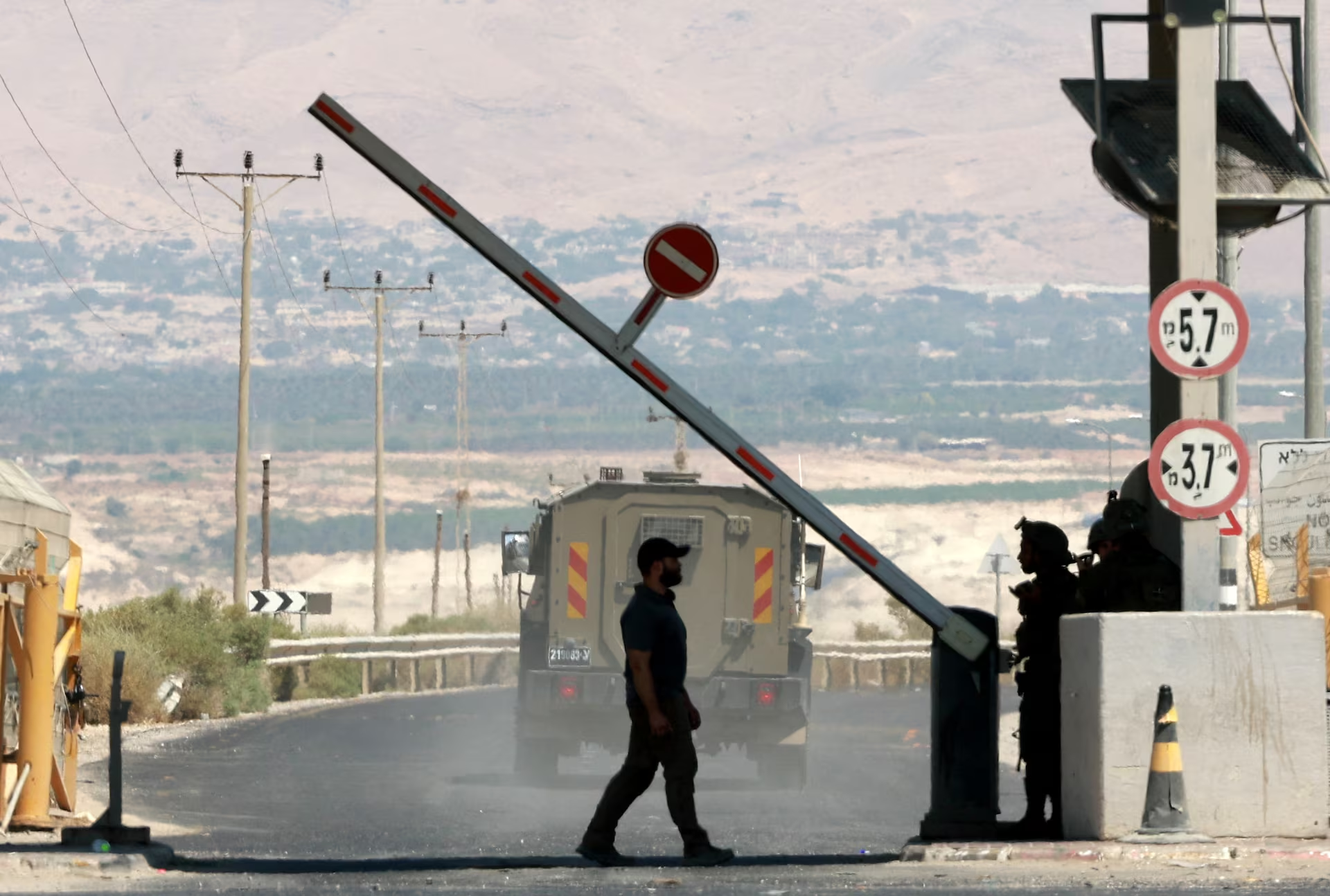
The escalating transit crisis at the King Hussein Bridge – Al Karameh (Allenby) Crossing—manifested in congestion, prolonged waiting lines, and repeated closures—demonstrates that it is not merely an operational malfunction detached from its political context. Rather, it constitutes a complex, layered crisis shaped by overlapping Israeli restrictions on movement and mobility through procedural controls (operating hours, number of buses, sudden…
Read More »
The ongoing war in Lebanon can no longer be understood as a limited military round between Israel and Hezbollah, nor even as a subsidiary extension of the U.S.–Israeli confrontation with Iran. Recent developments indicate that the conflict has shifted to a new level, where immediate military objectives are intertwined with broader strategic stakes related to reshaping Lebanon’s strategic environment and…
Read More »
This assessment proceeds from the premise that the Israeli–U.S. war on Iran has moved beyond the stage of proxy warfare into a phase of gradual attrition, cost escalation, and the reconfiguration of the region’s geopolitical and strategic environment. Drawing on a modified Delphi approach that synthesizes the assessments of a number of experts and researchers, the paper seeks to distill…
Read More »