
The End Game Inside Iran: Reformists vs Conservatives

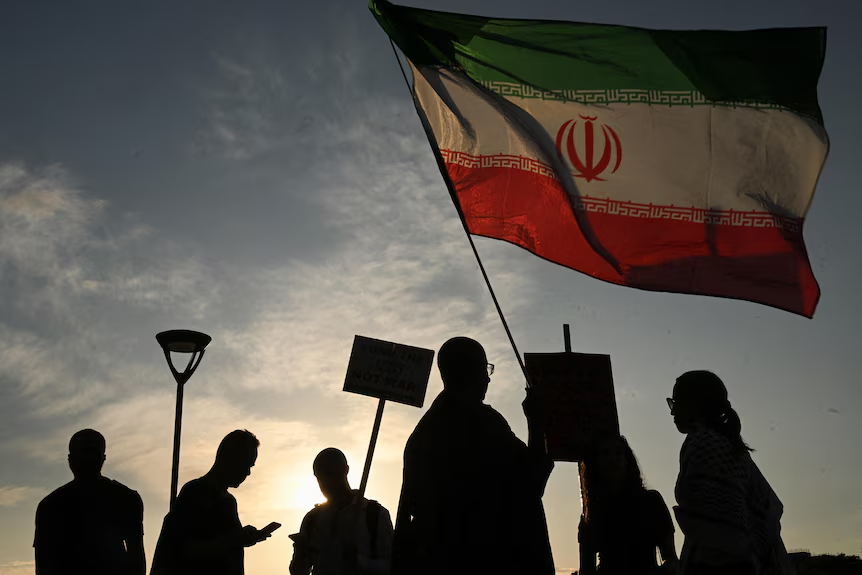
The outbreak of war in 2026 has profoundly reshaped Iran’s political landscape, intensifying long-standing tensions between reformist and conservative currents within the Islamic Republic. Conventional wisdom suggests that wartime conditions-marked by heightened securitization, centralization of authority, and intolerance for dissent-inevitably marginalize reformist actors, by subordinating political pluralism to regime survival. Indeed, early assessments point to the consolidation of power among hardline institutions, particularly those linked to the security apparatus, raising questions about whether reformists retain any meaningful role in shaping political outcomes.
Yet this view risks oversimplifying the nature of influence within the Iranian system. While reformists may have been pushed further from formal decision-making centers, their role cannot be assessed solely through institutional visibility. War, by exacerbating economic strain, social pressure, and international isolation, may simultaneously generate conditions in which reformist ideas-particularly those centered on de-escalation, diplomacy, and economic pragmatism-regain relevance, even if indirectly. This creates a more complex dynamic in which reformists appear politically weakened, yet structurally embedded within the system’s broader strategies of adaptation and survival.
Within ongoing debates on wartime Iran, two competing interpretations of reformist influence tend to dominate. One perspective treats reformists as largely marginalized and politically inconsequential, while another suggests that they continue to exert influence from the periphery through discursive and societal channels. Each of these readings captures part of the empirical reality, yet neither is sufficient on its own. What appears more analytically persuasive is to view the current moment not as the disappearance of reformism, but as a transformation in its function. In this sense, reformists no longer operate primarily as institutional contenders to conservative power; rather, they persist as a latent force within the system-one that constrains, legitimizes, and at times subtly redirects state behavior without directly exercising control. Such a reframing proves essential for understanding Iran’s evolving internal dynamics, as well as for anticipating how wartime conditions may shape both the trajectory of the conflict and the contours of its eventual resolution.
One prominent line of analysis holds that the reformist discourse has been virtually stifled since 2005 following the election of President Mahmoud Ahmadinejad, a hardliner who undid all the attempts of previous reformist presidents to engage in dialogue with the West, and that this kind of discourse was only radicalized and amplified by wartime conditions. According to Dr. Mahjoub Al Zuweiri[1], a professor of contemporary Middle Eastern history whose research focuses on Iran and the Gulf region, “Iran perceives these wars as being imposed on them, and that this circumstance will only further radicalize Iran’s stance post-war.” This view reflects a broader argument that war accelerates processes of securitization, narrowing the space for political pluralism and consolidating authority within hardline networks. Even though the war was marketed to the Iranians as a war of liberation from the oppression of their own regime, after the violent crackdown on protesters since December 2025 Iranians quickly realized that it was only a façade aimed to instill a regime change from below. With the targeting of important cultural sites within Iran, as well as the targeting of a school for girls in the very first days of the war, mistrust towards the actual intentions of the US and Israel was instilled.
In contrast, a competing interpretation suggests that reformists continue to exert influence, albeit in less visible ways. As Dr. Mohammed Abu Rumman[2], a political scientist and expert on political thought, argued in an interview conducted in March 2026, “the reformists still hold a very strong social base in Iranian society as they bridge the gap between the nature of the regime and the ordinary people, providing an opportunity to counter the narrative of the hardliners who tend to dismiss the desires of the people.” From this perspective, reformists function less as institutional actors and more as a discursive and societal force, shaping how the state navigates economic and political pressures. In the current unfolding of events, the most important role of the pragmatic or reformist faction, represented by the Foreign Minister Abbas Araghchi and the sitting President Masoud Pezeshkian, will prove crucial in the event of a major turning point within Iran shaped by a weakening of the regime; the reformists will most likely step in to provide an alternative since the stakes are incredibly high, with the survival of the state being threatened. This view is based on a more diplomatic take and on a willingness to converse with the West, especially the US. However, will such a dialogue be even possible considering that the war no longer singles out the regime, but targets the wellbeing of the people as well? The question of mistrust arises yet again, as the US has proven to be unreliable in fostering any kind of relationship with the people of Iran despite hostility towards their regime.
If the interpretation of Dr. Al Zuweiri holds, the trajectory of the Iranian system points toward a more consolidated security state in which decision-making remains tightly concentrated within hardline institutions. In such a scenario, the war is likely to be prosecuted-and eventually concluded-on terms defined primarily by military and strategic considerations rather than political compromise. The marginalization of reformist actors would also suggest limited prospects for diplomatic flexibility in the post-war phase, reinforcing a model of governance that prioritizes regime security over reintegration into the international system.
By contrast, if reformist influence persists in indirect or discursive forms, the longer-term trajectory appears more contingent. In Dr. Abu Rumman’s reading, the pressures generated by the war-economic strain, social discontent, and international isolation-may gradually reintroduce reformist ideas into the policymaking process, particularly in areas related to diplomacy and economic management. This would increase the likelihood that the conflict’s endgame involves some form of negotiated de-escalation, with reformist-oriented approaches shaping the terms of Iran’s post-war adjustment rather than determining them outright.
The divergence between these perspectives lies not only in their assessment of present influence, but in their implicit assumptions about the trajectory of the Iranian state. Both perspectives capture important dimensions of Iran’s wartime dynamics, yet each rests on a partial understanding of how influence operates under conditions of prolonged conflict. The first view correctly identifies the erosion of reformist presence within formal institutions, but risks equating institutional exclusion with political irrelevance. The second highlights the continuity of reformist ideas within the system, yet may overstate their capacity to translate into concrete policy outcomes under conditions of heightened securitization.
A more plausible interpretation is that the war is producing a functional transformation of reformism rather than its disappearance or persistence in traditional form. Under these conditions, the likely endgame is neither a fully consolidated hardline order nor a meaningful reformist resurgence. Instead, the system may evolve toward a hybrid configuration in which hardline actors retain decisive control over security and strategic policy, while selectively incorporating reformist-oriented approaches in areas where regime survival requires flexibility-particularly in managing economic recovery and external relations. This suggests that the conclusion of the war will not resolve the tension between reform and conservatism, but rather institutionalize it in a more asymmetrical form, where reformist influence is contingent, instrumental, and ultimately subordinate to the priorities of the security state.
[1] The interview was conducted online, via Zoom, in March 2026.
[2] The interview was conducted face to face, at the Politics and Society Institute in Amman, Jordan, in March 2026.