
Bangladesh Elections and the Rise of Jamaat-e-Islami: A Shift in Political Equilibria

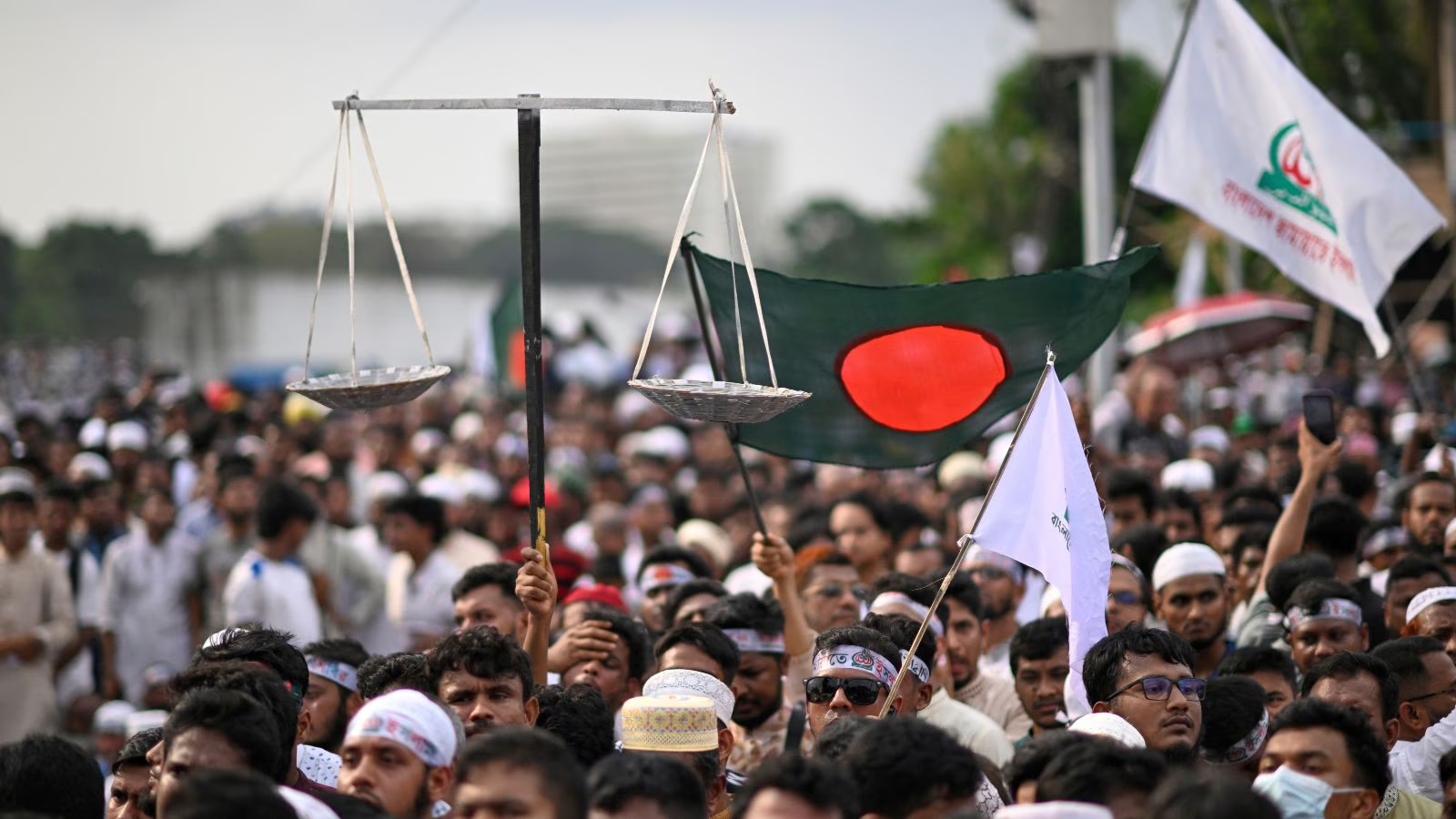
Elections constitute pivotal moments that not only reflect the will of voters but may also reveal shifts in the internal balance of political power within a state-particularly when their outcomes diverge from patterns that have long defined the political landscape. This is currently evident in Bangladesh following the announcement of parliamentary election results, which showed the Bangladesh Nationalist Party securing more than two hundred seats, while Jamaat-e-Islami emerged as the second-largest political force with nearly seventy seats. This marks its most significant electoral advance in decades within the National Parliament, which consists of 300 directly elected members, in addition to 50 seats reserved for women and allocated to parties in proportion to their overall representation.
These elections carry particular significance as they represent the first parliamentary contest following the end of the period of dominance by the Awami League under the leadership of Sheikh Hasina Wajed, who governed the country from 2009 until the collapse of her government in 2024 in the wake of widespread popular protests-marking the longest uninterrupted tenure in modern Bangladeshi history. During this period, Jamaat-e-Islami was subjected to stringent political and legal restrictions, especially after the Supreme Court of Bangladesh ruled in 2013 that its registration as a political party was unlawful, effectively barring it from electoral participation. With the conclusion of this legal ruling, a transitional phase emerged that reshaped the distribution of influence among political actors, a shift that was reflected in the movement’s electoral performance.
Since Bangladesh’s independence in 1971, the political system has largely been structured around a bipolar competition between the Awami League and the Bangladesh Nationalist Party, both of which alternated in power and constituted the central poles of political life. Jamaat-e-Islami, by contrast, remained a secondary political force with limited representation and had never previously occupied the position of the second-largest party in parliament; even at the height of its earlier electoral performance, its representation did not exceed 17 to 18 seats.
The origins of Jamaat-e-Islami trace back to the establishment of the parent movement, Jamaat-e-Islami, in 1941 by the Islamic thinker Abul A‘la Maududi in the Indian subcontinent during the period of British rule. From its inception, the movement was founded upon a vision that conceived Islam as a comprehensive framework governing political and social life, and it sought to establish a political order grounded in Islamic reference through structured organizational and institutional work. Intellectually, the movement belongs to the modern Islamic reformist tradition and intersected in several conceptual areas with the Muslim Brotherhood, while maintaining organizational independence within the South Asian context. Following the partition of the Indian subcontinent in 1947, Bangladesh became part of Pakistan under the designation “East Pakistan,” where the local branch of the movement was established and began building an organizational base within universities and religious institutions, thereby acquiring an early political and social presence.
This trajectory, however, was fundamentally disrupted after Bangladesh gained independence in 1971, when Sheikh Mujibur Rahman-the founder of the state and its first prime minister-banned Jamaat-e-Islami. The ban remained in place until the late 1970s, when political transformations allowed its gradual return to political activity. The movement subsequently reorganized its ranks and participated in elections, consolidating a structured political presence that reached its peak in the early 2000s, when Jamaat joined the government as part of a coalition with the Bangladesh Nationalist Party. Several of its leaders assumed ministerial positions, including Matiur Rahman Nizami as Minister of Agriculture and Ali Ahsan Mohammad Mujahid as Minister of Social Welfare between 2001 and 2006.
Nevertheless, the movement faced one of its most critical phases following the return of the Awami League to power in 2009. In 2010, the government established the International Crimes Tribunal to prosecute individuals accused of crimes committed during the 1971 war. These trials, conducted nearly four decades after the conflict, led to the execution of several of the movement’s most prominent leaders, including its former amir, Matiur Rahman Nizami, in 2016, and Secretary-General Ali Ahsan Mohammad Mujahid in 2015, constituting a major blow to the party’s leadership structure. Despite this, Jamaat maintained its organizational presence through its social networks and its student wing, Islami Chhatra Shibir, which achieved notable results in student union elections over the past two years, including winning 8 of 11 seats at one university and 19 of 20 seats at another-signaling a marked resurgence of the movement’s influence among youth.
The movement’s rise in these elections coincides with the emergence of a new generation of leadership, headed by its current amir, Shafiqur Rahman, who has led the party since 2019 and has worked to reorganize its structures and recalibrate its political discourse in response to evolving circumstances. Jamaat has capitalized on widespread social and economic discontent-particularly among youth-stemming from unemployment, rising living costs, and declining trust in traditional parties. It has thus repositioned itself through a platform emphasizing social justice, anti-corruption measures, and economic development.
The election results reflect a clear political resurgence of Jamaat-e-Islami; however, they do not necessarily indicate a comprehensive ideological shift within Bangladeshi society as much as they signal a reconfiguration of political balances during a transitional phase. The movement’s position as the second-largest party in parliament grants it renewed political weight and reintroduces it into the sphere of influence in public life-whether through its role in legislative deliberations or in shaping alliances and power balances among political actors-after years of exclusion and marginalization. This influence will persist regardless of whether it participates in the formation of the next government through arrangements led by the majority party or remains outside it.
At the international level, this development is viewed as part of a broader pattern of the repositioning of Islamic movements within political systems through democratic mechanisms. Regional and international actors are closely monitoring the shift, particularly India and Pakistan, given Bangladesh’s strategic location, its economic significance, and its status as one of South Asia’s largest emerging economies. This attention carries particular sensitivity in India, where former Prime Minister Sheikh Hasina Wajed currently resides and where she has long been regarded as a key ally.
Ultimately, the sustainability of this political ascent will depend on Jamaat’s ability to institutionalize its presence within the framework of formal political practice and to navigate the complexities of a new phase shaped by the redistribution of power within parliament and the nature of the alliances that will emerge from it. This will unfold within a fluid domestic environment, marked by regional instability and intricate relations with influential regional actors. Accordingly, the manner in which this electoral advance is managed-politically and within parliament-will determine whether the movement succeeds in consolidating a durable position within the equation of power and in reshaping its future political trajectory.